 English
 EUR €
EUR €
In stock
Tesamorelin
€70
Synthetic pentapeptide, Aib-His-D-2-Nal-D-Phe-Lys-NH2, C-terminal carboxamide
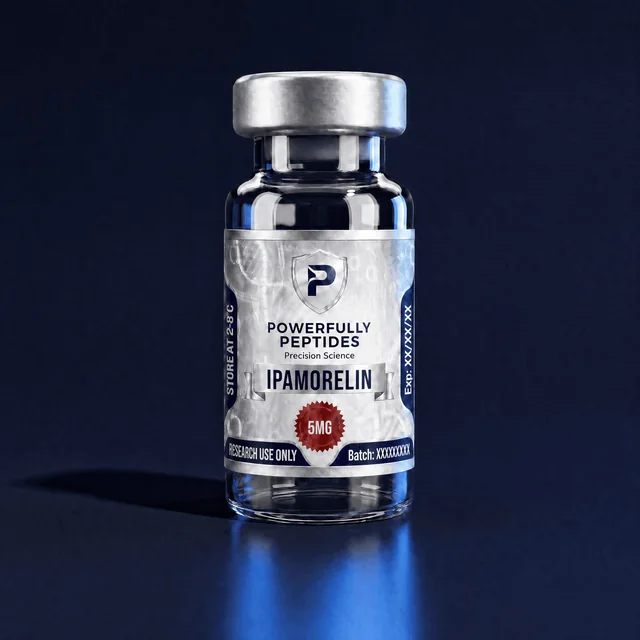
Ipamorelin is a synthetic pentapeptide and selective growth-hormone secretagogue that acts as a ghrelin/GHS-receptor agonist. In research it is valued as a comparatively selective tool compound for in-vitro studies of GH-secretagogue-receptor signalling.
This page serves European research buyers sourcing ipamorelin for laboratory work. Supplied as a 5 mg lyophilised vial strictly for research — not for human or veterinary use — to a ≥99% purity target, tested every batch, and shipped tracked from inside Europe. Independent per-batch Certificate-of-Analysis testing is our published testing standard.
Looking for something else? Browse all research peptides → · reconstitution calculator
Ipamorelin is a synthetic pentapeptide with the sequence Aib-His-D-2-Nal-D-Phe-Lys-NH2 (free peptide: CAS 170851-70-4, C38H49N9O5, 711.87 g/mol). It does not occur in nature. The molecule originated in a Novo Nordisk peptide programme under the development code NNC 26-0161 and was first characterised in the peer-reviewed literature by Raun and colleagues in 1998, who report that it was identified within a series of compounds lacking the central Ala-Trp dipeptide of growth hormone releasing peptide-1. The only published clinical study was sponsored by Helsinn Therapeutics (U.S.), Inc.
All presented information is based on scientific publications which can be found at the end of product description below.
The product is intended for scientific research and development purposes only. Chemical substances shall not be used as a drug, medicine, active substance, medical aid, cosmetic product, a substance for production of a cosmetic product neither for human consumption that is any food or food supplement or otherwise similarly used on humans or animals. Intended only for in-vitro research, such as Receptor-ligand binding studies, Enzyme activity assays, Cell proliferation assays, Cell signaling assays, Epitope mapping, ect.
Peptides in lyophilized form are supplied in glass vials by standard shipping methods and do not require refrigeration. Short-term temperature fluctuations during transport will not reduce their quality and efficacy. Even at high summer temperatures, the peptides in lyophilized form are stable for several weeks.
Upon receiving the lyophilized peptide, store at 4 °C or colder and away from bright light. Lyophilized peptides are stable at room temperature for weeks, but for longer-term storage, it is safer to store at -20 °C or colder. Exposure to moisture will greatly decrease long-term stability of lyophilized peptides. Before using the peptide, remove from cold storage and allow the peptide to equilibrate to room temperature before removing the lid of the container, in order to reduce the uptake of moisture that is present in the surrounding atmosphere.
The shelf life of peptide solutions is limited. Freezing the aliquots will prolong the storage life of the peptide. What is globally accepted for peptides in solution is that they are generally stable for 3 or more weeks at +4°C and for 3-4 months at -20°C. Avoid repeated freeze-thaw cycles, as this can degrade the peptides.
Used solely for in vitro experiments and cannot be:
Neutral reference material and handling tools from across the site. Research use only.
Compounds studied in growth-hormone axis research.
ReferenceWhat the 0.9% benzyl alcohol preservative does, the 28-day in-use window, and which vial size fits your work.
ToolWork out the exact bacteriostatic water to add and the volume to draw for a target research concentration.
Ipamorelin is a synthetic pentapeptide with the sequence Aib-His-D-2-Nal-D-Phe-Lys-NH2 (free peptide: CAS 170851-70-4, C38H49N9O5, 711.87 g/mol). It does not occur in nature. The molecule originated in a Novo Nordisk peptide programme under the development code NNC 26-0161 and was first characterised in the peer-reviewed literature by Raun and colleagues in 1998, who report that it was identified within a series of compounds lacking the central Ala-Trp dipeptide of growth hormone releasing peptide-1. The only published clinical study was sponsored by Helsinn Therapeutics (U.S.), Inc.
Four features define its chemistry. The N-terminal residue is Aib (2-aminoisobutyric acid), an achiral, alpha,alpha-disubstituted amino acid not used in ribosomal protein synthesis. Positions three and four are D-amino acids: D-3-(2-naphthyl)alanine, a bulky bicyclic aromatic residue, and D-phenylalanine. The C-terminus is a carboxamide rather than a free acid. D-configuration residues, alpha,alpha-disubstitution at the N-terminus and C-terminal amidation are the standard medicinal-chemistry modifications used to build peptides that resist the amino- and carboxypeptidases acting on ordinary L-peptides; PowerfullyPeptides makes no measured stability claim for this material beyond the storage conditions stated on the specification. The only standard residues are L-histidine and L-lysine, whose imidazole and epsilon-amino groups give the molecule its basic character.
Structurally, ipamorelin sits apart from the two other families of compounds studied on the growth hormone axis. Ghrelin, the endogenous ligand of the GHS-R1a receptor, is a 28-residue peptide that requires an n-octanoyl group on Ser3 for receptor activity. GHRH is a 44-residue peptide and its common analogues run to 29 residues. Ipamorelin carries no lipid modification, no cysteine and therefore no disulfide bridge, and at roughly 712 Da it is a fraction of the mass of either. It is produced by solid-phase peptide synthesis, purified by reversed-phase HPLC and isolated by lyophilisation as the acetate salt. Because the supplied material is the acetate salt rather than the free peptide, and because residual acetate counterions and bound water are part of the dried powder, gross vial mass and net peptide mass are not identical; the free peptide has a formula mass of 711.87 g/mol against 771.9 g/mol for the monoacetate. This material is supplied at >=99% purity by HPLC.
The defining pharmacology paper is Raun et al. (1998). In primary rat pituitary cells the authors reported an EC50 of 1.3 +/- 0.4 nmol/L with 85 +/- 5% of maximal efficacy, against 2.2 +/- 0.3 nmol/L and 100% efficacy for GHRP-6. In pentobarbital-anaesthetised rats the reported ED50 was 80 +/- 42 nmol/kg, producing 1545 +/- 250 ng GH/mL, versus 115 +/- 36 nmol/kg and 1167 +/- 120 ng GH/mL for GHRP-6. In conscious swine the reported ED50 was 2.3 +/- 0.03 nmol/kg yielding 65 +/- 0.2 ng GH/mL of plasma, against 3.9 +/- 1.4 nmol/kg and 74 +/- 7 ng GH/mL for GHRP-6. Specificity was studied in swine: the authors report that none of the secretagogues tested affected FSH, LH, prolactin or TSH plasma levels, that GHRP-6 and GHRP-2 both raised plasma ACTH and cortisol, and that ipamorelin did not release ACTH or cortisol at levels significantly different from those observed following GHRH stimulation, an absence of difference that persisted at doses more than 200-fold above the ED50 for GH release. That comparison between compounds, not any outcome, is what the paper is cited for.
Two rodent skeletal studies followed. Johansen et al. (1999) gave adult female rats 0, 18, 90 or 450 micrograms daily by subcutaneous injection in three divided doses for 15 days. Longitudinal bone growth rate measured 42 micrometres/day in the vehicle group against 44, 50 and 52 micrometres/day in the three dose groups (P<0.0001), alongside dose-dependent body weight gain. The same study found no significant effect on total IGF-I, IGF binding proteins, or serum markers of bone formation and resorption, and reported a marginally reduced plasma GH response to ipamorelin after the treatment period (P<0.03) with an unchanged response to GHRH. Svensson et al. (2000) infused 0.5 mg/kg/day of ipamorelin continuously for 12 weeks in adult female rats, alongside GHRP-6 at 0.5 mg/kg/day. Body weight and total tibial and vertebral bone mineral content measured by DXA rose relative to vehicle-treated controls, but the increase disappeared once corrected for body weight change, and volumetric bone mineral density was unchanged; the authors attributed the change to increased bone growth and bone dimensions rather than increased density.
Human pharmacokinetic data come from a single published study. Gobburu et al. (1999) used a dose-escalation design with five 15-minute infusion rates (4.21, 14.02, 42.13, 84.27 and 140.45 nmol/kg) and eight healthy male subjects at each dose level. They reported that the pharmacokinetic parameters showed dose-proportionality, with a terminal half-life of approximately 2 hours, clearance of 0.078 L/h/kg and a volume of distribution of 0.22 L/kg. Growth hormone response was fitted with an indirect response model giving an SC50 for half-maximal GH stimulation of 214 nmol/L and a maximal GH production rate of 694 mIU/L/h. The authors noted that inter-individual variability in the pharmacodynamic parameters was larger than that of the pharmacokinetic parameters.
A separate line of work examined gastrointestinal motility rather than the growth hormone axis. Greenwood-Van Meerveld et al. (2012) used a rat model of postoperative ileus induced by abdominal surgery, administering ipamorelin at 0.014 to 0.14 micromol/kg intravenously. Surgery delayed gastric emptying, leaving 78 +/- 5% of the meal in the stomach in vehicle-treated animals against 44 +/- 6% in non-surgical controls. At 0.014 micromol/kg, 52 +/- 11% of the meal remained (P<0.05 versus vehicle). In isolated gastric fundus preparations, ipamorelin at 1 micromolar reversed the surgery-induced inhibition of contraction. The authors attributed the effect to ghrelin-receptor-mediated activation of cholinergic excitatory neurons.
That preclinical work led to the only published controlled trial. Beck et al. (2014) ran a phase 2, randomised, double-blind, placebo-controlled proof-of-concept study (NCT00672074, sponsored by Helsinn Therapeutics (U.S.), Inc.) in bowel resection patients: 117 patients enrolled, of whom 114 composed the safety and modified intent-to-treat populations, receiving intravenous infusions of 0.03 mg/kg twice daily on postoperative day 1 to 7 or hospital discharge. Median time to first tolerated meal was 25.3 hours on ipamorelin against 32.6 hours on placebo, p = 0.15. Adverse events occurred in 87.5% of the ipamorelin group and 94.8% of the placebo group. The authors concluded that the regimen was well tolerated and that there were no significant differences between ipamorelin and placebo in the key and secondary efficacy analyses. The trial completed in December 2009. Ipamorelin holds no marketing authorisation in Europe or the US. The published record overall is modest: a small cluster of rodent endocrinology and gastrointestinal motility studies from the late 1990s and 2000s, one human pharmacokinetic study, and one phase 2 trial that missed its endpoint. There is no long-term human safety dataset.
PowerfullyPeptides supplies Ipamorelin as a 5 mg lyophilised vial to research buyers across Europe, dispatched tracked from inside Europe. Sold strictly for laboratory research use only.
In the laboratory, Ipamorelin is studied as a selective growth-hormone-secretagogue-receptor agonist tool compound, used in in-vitro GHS-receptor signalling models. Supplied for research only; no human- or animal-use claims are made.
Material is specified to a ≥99% purity target and tested every batch. Independent per-batch Certificate-of-Analysis testing is our published testing standard — see our COA page.
€70
€110
€129
€35
€50
€50