 English
 EUR €
EUR €
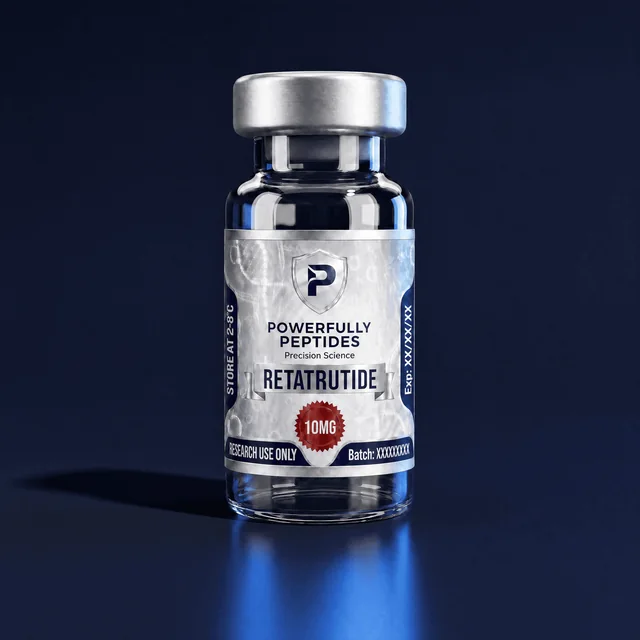
In stock
Retatrutide
€110
Synthetic pentadecapeptide, sequence GEPPPGKPADDAGLV, free-acid C-terminus
BPC-157 ist ein synthetisches Pentadecapeptid, das von einer Teilsequenz des im Magensaft vorkommenden Body-Protection-Compounds abgeleitet ist. Im Labor zählt es zu den am häufigsten untersuchten Peptiden in Modellen zur Bindegewebs- und Magen-Darm-Reparatur, wobei sich die Forschung auf Angiogenese- und Fibroblastenmigrations-Signalwege konzentriert.
Diese Seite richtet sich an Forschungseinkäufer in Europa, die BPC-157 für In-vitro- und präklinische Arbeiten beziehen. Jede Durchstechflasche wird ausschließlich für die Laborforschung geliefert — nicht für den menschlichen oder tierärztlichen Gebrauch. Das Material hat ein Reinheitsziel von ≥99 % und ist chargenverfolgt; der Versand erfolgt verfolgt aus Europa. Unabhängige chargenbezogene Analysenzertifikate (COA) sind unser veröffentlichter Prüfstandard.
Sie suchen etwas anderes? Alle Forschungspeptide ansehen → · Rekonstitutions-Rechner
BPC-157 is a synthetic pentadecapeptide: a single, non-glycosylated chain of fifteen amino acids with the sequence Gly-Glu-Pro-Pro-Pro-Gly-Lys-Pro-Ala-Asp-Asp-Ala-Gly-Leu-Val. Its molecular formula is C62H98N16O22 and its free-base average molecular weight is 1419.56 g/mol. It carries CAS registry number 137525-51-0, which the FDA's own compounding briefing material records as matching the free base rather than a salt. The name is an abbreviation of Body Protection Compound 157. The designations PL-10, PLD-116 and PL-14736 appear for the same molecule in the older literature (McGuire et al., 2025; the same three synonyms are recorded on PubChem CID 9941957).
All presented information is based on scientific publications which can be found at the end of product description below.
The product is intended for scientific research and development purposes only. Chemical substances shall not be used as a drug, medicine, active substance, medical aid, cosmetic product, a substance for production of a cosmetic product neither for human consumption that is any food or food supplement or otherwise similarly used on humans or animals. Intended only for in-vitro research, such as Receptor-ligand binding studies, Enzyme activity assays, Cell proliferation assays, Cell signaling assays, Epitope mapping, ect.
Peptides in lyophilized form are supplied in glass vials by standard shipping methods and do not require refrigeration. Short-term temperature fluctuations during transport will not reduce their quality and efficacy. Even at high summer temperatures, the peptides in lyophilized form are stable for several weeks.
Upon receiving the lyophilized peptide, store at 4 °C or colder and away from bright light. Lyophilized peptides are stable at room temperature for weeks, but for longer-term storage, it is safer to store at -20 °C or colder. Exposure to moisture will greatly decrease long-term stability of lyophilized peptides. Before using the peptide, remove from cold storage and allow the peptide to equilibrate to room temperature before removing the lid of the container, in order to reduce the uptake of moisture that is present in the surrounding atmosphere.
The shelf life of peptide solutions is limited. Freezing the aliquots will prolong the storage life of the peptide. What is globally accepted for peptides in solution is that they are generally stable for 3 or more weeks at +4°C and for 3-4 months at -20°C. Avoid repeated freeze-thaw cycles, as this can degrade the peptides.
Used solely for in vitro experiments and cannot be:
Neutral reference material and handling tools from across the site. Research use only.
Compounds examined in tissue-repair and recovery models.
ReferenceWhat the 0.9% benzyl alcohol preservative does, the 28-day in-use window, and which vial size fits your work.
ToolWork out the exact bacteriostatic water to add and the volume to draw for a target research concentration.
BPC-157 is a synthetic pentadecapeptide: a single, non-glycosylated chain of fifteen amino acids with the sequence Gly-Glu-Pro-Pro-Pro-Gly-Lys-Pro-Ala-Asp-Asp-Ala-Gly-Leu-Val. Its molecular formula is C62H98N16O22 and its free-base average molecular weight is 1419.56 g/mol. It carries CAS registry number 137525-51-0, which the FDA's own compounding briefing material records as matching the free base rather than a salt. The name is an abbreviation of Body Protection Compound 157. The designations PL-10, PLD-116 and PL-14736 appear for the same molecule in the older literature (McGuire et al., 2025; the same three synonyms are recorded on PubChem CID 9941957).
The sequence is described by Sikiric and colleagues at the University of Zagreb as a partial sequence of BPC, a protein the group reported in human gastric juice in the early 1990s. Material described in the published studies, and material offered commercially, is chemically synthesised rather than extracted; the compound is assembled by standard solid-phase peptide synthesis. Huang et al. (2015) characterised the preparation made in their own laboratory as 99% pure by HPLC and identified 1-des-Gly peptide, the sequence missing its N-terminal glycine, as the principal impurity, which is the deletion sequence most likely to appear in material of this type. Purity and impurity profile are properties of a given lot, not of the molecule, and belong on a lot-specific certificate of analysis.
Structurally the peptide is unremarkable in a way that matters for handling. It contains no cysteine and therefore no disulfide bridges, no unnatural amino acids, and no C-terminal amidation; PubChem records it as the free acid, H-GEPPPGKPADDAGLV-OH. Four of the fifteen residues are proline, three of them consecutive at positions 3 to 5, which constrains the backbone. One lysine and three acidic residues (Glu2, Asp10, Asp11) give the molecule a net negative charge at neutral pH. Huang et al. (2015) describe the peptide as freely soluble in water at pH 7.0 and in saline. Suppliers commonly ship the material as an acetate or trifluoroacetate salt, in which case the stated vial mass includes counter-ion and the net peptide content is lower; a certificate of analysis should state which salt form was supplied.
The published record on this compound is large in article count and narrow in study type. A 2025 systematic review in HSS Journal searched PubMed, Cochrane and Embase to June 2024 and identified 544 articles on BPC-157 published between 1993 and 2024. After duplicates were removed and screening applied, 36 studies met the inclusion criteria: 35 preclinical and 1 clinical (Vasireddi et al., 2025). A separate 2025 review reached the same conclusion from the other direction, reporting that only three pilot studies have examined BPC-157 in humans and stating that the compound should be considered investigational until well-designed clinical trials are conducted (McGuire et al., 2025). A large share of the preclinical work originates with the Sikiric group in Zagreb and its collaborators, which is relevant when weighing how independently the findings have been replicated.
The connective-tissue literature is mostly cell and explant work from a single Taiwanese group. Chang et al. (2011) cultured tendon explants and fibroblasts from rat Achilles tendon and reported that BPC 157 significantly accelerated the outgrowth of tendon explants and markedly increased in-vitro migration in a transwell filter assay in a dose-dependent manner, while the MTT assay showed that cell proliferation was not directly affected; survival of treated cells was significantly increased under hydrogen peroxide stress, and the authors reported dose-dependent increases in phosphorylation of FAK and paxillin with total protein unaltered, attributing the migration finding to activation of the FAK-paxillin pathway. A follow-up from the same laboratory (Chang et al., 2014) reported that BPC 157 dose- and time-dependently increased growth hormone receptor expression in tendon fibroblasts at both mRNA and protein level, with time-dependent activation of Janus kinase 2 when growth hormone was subsequently added.
Vascular and angiogenesis work forms the second cluster. Hsieh et al. (2017) examined a rat ischaemic hindlimb model and endothelial cells and reported accelerated recovery of blood flow in ischaemic muscle, an increased number of vessels, increased mRNA and protein expression of VEGF receptor 2, and time-dependent activation of the VEGFR2-Akt-eNOS signalling pathway. Huang et al. (2015) treated human umbilical vein endothelial cells at in-vitro concentrations of 1, 5 and 10 micrograms per mL and reported enhanced proliferation by MTT and cell cycle analysis, increased migration in transwell and scratch assays, accelerated tube formation on matrigel, and raised VEGF-a at both mRNA and protein level; a gene array showed c-Fos, c-Jun and Egr-1 upregulated 4.99-, 7.05- and 3.70-fold respectively, with western blot showing regulation of ERK1/2 phosphorylation. In the same paper a rat alkali-burn model treated with topical hydrogel showed greater wound closure, granulation tissue formation and collagen deposition than controls at day 18. These are cell-culture and animal-model concentrations reported by the authors, not guidance of any kind.
The original line of investigation was gastrointestinal. Sikiric et al. (2011) reviewed roughly two decades of rodent work on gastric and duodenal lesion models, including alcohol-induced and non-steroidal anti-inflammatory drug-induced lesions, and set out the group's central chemical claim about this peptide: that it is stable in human gastric juice. That claim is the group's own, stated in their review, and it is the property they cite in pursuing the peptide as an orally administrable candidate.
Human and regulatory data are the thin part of the file and should be stated plainly. The one clinical study captured by the HSS Journal review was retrospective: 7 of 12 patients reported relief for more than six months following intra-articular injection for unspecified chronic knee pain. The same review states that BPC-157 is metabolised in the liver with a half-life of less than 30 minutes and is cleared by the kidneys, that preclinical safety studies showed no adverse effects across several organ systems, and that no clinical safety data were found (Vasireddi et al., 2025). McGuire et al. (2025) identify the three human reports as an intra-articular knee study, an interstitial cystitis study, and an intravenous safety and pharmacokinetics study.
Regulatory status is the part of the file that moves fastest and is given here with dates. The World Anti-Doping Agency added BPC-157 by name to section S0 (Non-Approved Substances) of its 2022 Prohibited List following a re-evaluation; WADA's own summary of major modifications records this as the first time a substance was included by name as an example in that section, and BPC-157 remains listed under S0 on the current Prohibited List. In the United States the peptide has never been approved as a drug. The FDA placed it in Category 2 of its interim 503A bulk drug substances policy in 2023, citing potential immunogenicity risk for certain routes of administration, complexity with regard to peptide-related impurities and active pharmaceutical ingredient characterisation, and insufficient safety information for the proposed routes; that rationale still appears on the FDA's compounding page, where BPC-157 now sits under bulk drug substances nominated but withdrawn. In April 2026 the FDA reclassified twelve peptides including BPC-157 out of Category 2, the nominations having been withdrawn by the nominators. On 23 July 2026 the agency's Pharmacy Compounding Advisory Committee voted 8 to 6 with one abstention to recommend adding BPC-157, free base and acetate, to the 503A Bulks List. The FDA is not bound by that recommendation, formal notice-and-comment rulemaking would be required to act on it, and as of this writing BPC-157 is not on the 503A Bulks List and is not an approved drug.
PowerfullyPeptides liefert BPC-157 als 10-mg-Lyophilisat an Forschungseinkäufer in ganz Europa. Der Versand erfolgt verfolgt aus Europa. Der Verkauf erfolgt ausschließlich für Laborforschungszwecke.
Das Material hat ein Reinheitsziel von ≥99 % und ist chargenverfolgt, sodass sich eine Charge in Ihren Aufzeichnungen zurückverfolgen lässt. Unabhängige chargenbezogene Analysenzertifikate sind unser veröffentlichter Prüfstandard — auf unserer COA-Seite ist dokumentiert, wie Identität und Reinheit belegt werden.
Nein. BPC-157 wird ausschließlich für In-vitro- und Laborforschung geliefert. Wir machen keine Angaben zu Sicherheit oder Wirksamkeit bei Menschen oder Tieren, und nichts auf dieser Seite ist als medizinische Beratung zu verstehen.
€110
€129
€35
€50
€50
€70