 English
 EUR €
EUR €
In stock
Glow Blend
€129
Copper(II) complex of the tripeptide Gly-His-Lys
GHK-Cu ist der Kupferkomplex des Tripeptids Glycyl-L-histidyl-L-lysin (Kupfertripeptid-1), ein natürlich vorkommendes Molekül, das in der Forschung zu Hautumbau und extrazellulärer Matrix umfassend untersucht wurde. Im Labor ist es ein Standardwerkzeug für Arbeiten zur Kollagen- und Matrixproteinexpression sowie zur kupferabhängigen Signalübertragung.
Diese Seite richtet sich an europäische Forschungseinkäufer, die GHK-Cu für In-vitro-Studien in der Kosmetikwissenschaft und zum Matrixumbau beziehen. Lieferung ausschließlich für die Laborforschung — nicht für den menschlichen oder tierärztlichen Gebrauch — mit Reinheitsziel ≥99 %, chargenverfolgt und verfolgt aus Europa versandt. Unabhängige chargenbezogene Analysenzertifikate sind unser veröffentlichter Prüfstandard.
Sie suchen etwas anderes? Alle Forschungspeptide ansehen → · Rekonstitutions-Rechner
GHK-Cu is the copper(II) complex of glycyl-L-histidyl-L-lysine, a three-residue peptide with the sequence Gly-His-Lys. The free peptide has the formula C14H24N6O4 and a molecular weight of 340.38. Binding one Cu(II) ion displaces two protons, which gives the neutral 1:1 complex C14H22CuN6O4 at 401.91 g/mol. Pickart and Thaler isolated the tripeptide from human serum in 1973. The same Gly-His-Lys triplet occurs within the alpha-2(I) chain of type I collagen, a point Maquart and colleagues raised in 1988.
All presented information is based on scientific publications which can be found at the end of product description below.
The product is intended for scientific research and development purposes only. Chemical substances shall not be used as a drug, medicine, active substance, medical aid, cosmetic product, a substance for production of a cosmetic product neither for human consumption that is any food or food supplement or otherwise similarly used on humans or animals. Intended only for in-vitro research, such as Receptor-ligand binding studies, Enzyme activity assays, Cell proliferation assays, Cell signaling assays, Epitope mapping, ect.
Peptides in lyophilized form are supplied in glass vials by standard shipping methods and do not require refrigeration. Short-term temperature fluctuations during transport will not reduce their quality and efficacy. Even at high summer temperatures, the peptides in lyophilized form are stable for several weeks.
Upon receiving the lyophilized peptide, store at 4 °C or colder and away from bright light. Lyophilized peptides are stable at room temperature for weeks, but for longer-term storage, it is safer to store at -20 °C or colder. Exposure to moisture will greatly decrease long-term stability of lyophilized peptides. Before using the peptide, remove from cold storage and allow the peptide to equilibrate to room temperature before removing the lid of the container, in order to reduce the uptake of moisture that is present in the surrounding atmosphere.
The shelf life of peptide solutions is limited. Freezing the aliquots will prolong the storage life of the peptide. What is globally accepted for peptides in solution is that they are generally stable for 3 or more weeks at +4°C and for 3-4 months at -20°C. Avoid repeated freeze-thaw cycles, as this can degrade the peptides.
Used solely for in vitro experiments and cannot be:
Neutral reference material and handling tools from across the site. Research use only.
Compounds studied in dermal, pigmentation and collagen research.
ReferenceWhat the 0.9% benzyl alcohol preservative does, the 28-day in-use window, and which vial size fits your work.
ToolWork out the exact bacteriostatic water to add and the volume to draw for a target research concentration.
GHK-Cu is the copper(II) complex of glycyl-L-histidyl-L-lysine, a three-residue peptide with the sequence Gly-His-Lys. The free peptide has the formula C14H24N6O4 and a molecular weight of 340.38. Binding one Cu(II) ion displaces two protons, which gives the neutral 1:1 complex C14H22CuN6O4 at 401.91 g/mol. Pickart and Thaler isolated the tripeptide from human serum in 1973. The same Gly-His-Lys triplet occurs within the alpha-2(I) chain of type I collagen, a point Maquart and colleagues raised in 1988.
Freedman et al. (1982) examined the complex in solution using optical, EPR and electron spin-echo envelope spectroscopy. At neutral pH they described a mononuclear 1:1 Cu(II) species with the metal equatorially coordinated by two or three nitrogen atoms, one of them supplied by the histidyl imidazole ring. A pH titration gave three optical transitions with apparent pKs of 3.6, 9.2 and 11.4. The solid-state structure is different. That same paper cites an earlier X-ray crystallographic analysis describing a polymeric arrangement with oxygen-bridged Cu(II) pairs, and reports that this arrangement does not persist in water. The structural comparison the molecule is still described by comes from Pickart et al. (1980), who noted that the peptide's copper association resembles the copper transport sites on albumin and alpha-fetoprotein, where a cupric atom binds a histidyl residue adjacent to a basic residue.
Nomenclature around this compound is inconsistent and worth flagging. The INCI name is copper tripeptide-1. The CAS registry number is 89030-95-5, which the FDA substance registry ties to UNII 6BJQ43T1I9 and to the neutral formula C14H22N6O4 with copper at 401.9085. A separate registry number, 130120-57-9, covers the acetate salt, which appears in the pharmacological literature under the INN prezatide copper acetate. Public databases also carry the 1:1 complex at more than one protonation state, so published molecular weights range from 400.90 (anionic) through 401.91 (neutral) to 402.92 (cationic) for what is chemically the same species. The figure quoted on this page is the neutral form. The lyophilised powder is blue to blue-violet rather than white, a consequence of the d-d absorption of the Cu(II) centre; uncomplexed GHK is a white solid.
The published record begins with Pickart and Thaler (Nature New Biology, 1973), who isolated a tripeptide from human serum and reported that it prolonged the survival of normal liver cells in culture while stimulating growth in neoplastic liver tissue. Seven years later Pickart et al. (Nature, 1980) reported that the tripeptide readily forms complexes with copper(II) and enhances uptake of the metal into cultured hepatoma cells. In that same work, maximal effects on HTC4 hepatoma cells were seen when the peptide was added to the growth medium together with copper and iron, and structure-function comparisons found several tripeptides carrying a histidyl-lysyl linkage to be nearly as active. Those two papers set the framing that most later work inherited, in which the peptide is studied as a copper carrier rather than as a receptor ligand.
Fibroblast culture supplies the most quantitative data. Maquart et al. (FEBS Letters, 1988) measured collagen synthesis in cultured fibroblasts exposed to GHK-Cu and reported that the effect began between 1 and 10 pM, reached a maximum at 1 nM, and was independent of any change in cell number. Siméon et al. (Life Sciences, 2000) examined the other side of matrix turnover in dermal fibroblasts, reporting raised MMP-2 levels in conditioned media alongside raised MMP-2 mRNA, together with increased secretion of the tissue inhibitors TIMP-1 and TIMP-2. One control in that paper is worth isolating. The MMP-2 effect was reproduced by copper ions alone but not by the uncomplexed GHK peptide. That is the clearest published evidence that the copper, and not the peptide backbone on its own, carries this particular activity.
In-vivo work on the copper complex itself is sparse. The most fully reported controlled experiment is Cangul et al. (Veterinary Dermatology, 2006), run in eighteen New Zealand rabbits split into three groups: topical tripeptide-copper complex, zinc oxide, and no treatment. One full-thickness wound was created on each side of the dorsal midline, treated daily for 21 days, and traced on days 0, 7, 14 and 21. Mean unhealed wound area was significantly smaller in the copper-complex group than in untreated controls at days 7, 14 and 21, and significantly smaller than in the zinc oxide group at day 7. Median time to coverage of the wound bed with granulation tissue was significantly shorter in the copper-complex group than in the other two groups. This is an eighteen-animal rabbit study. It is not a human trial.
The gene-expression literature is what revived interest in the molecule after 2010. Campbell et al. (Genome Medicine, 2012) profiled 64 lung tissue samples, eight regions from each of eight lungs taken from smokers with COPD, and identified 127 genes whose expression levels were significantly associated with regional emphysema severity as quantified by mean linear intercept on micro-CT. Querying the Broad Institute Connectivity Map with that signature returned GHK, the free peptide, as a compound predicted to reverse it. The authors then treated human fibroblasts with GHK and reported gene-expression patterns resembling TGF-beta activation, organisation of the actin cytoskeleton, and elevated integrin beta-1 expression. An independent group arrived at the Connectivity Map by a different route: Hong et al. (Clinical and Experimental Metastasis, 2010; PMID 20143136) derived a 54-gene metastasis-prone signature from early-stage colorectal cancer samples and reported that, on querying the map with a 70% subset of those genes, Gly-His-Lys and securinine came back as the two perturbagens predicted to reverse the differential expression. Both are computational predictions, followed in the Campbell case by cell-culture work. Neither is a clinical finding.
Three caveats belong on this page. First, a large share of the review literature on GHK-Cu is authored by Loren Pickart, who discovered the peptide and whose published affiliation is the commercial R&D arm of Skin Biology, a copper-peptide cosmetics company; the widely repeated figure that plasma GHK falls from roughly 200 ng/mL at age 20 to 80 ng/mL by age 60 traces to those reviews rather than to an independently published measurement series, and we could not source a primary paper for it, so it is reproduced here only as an unsourced review claim. Second, several citations circulated as GHK-Cu hair research are not GHK-Cu at all. Pyo et al. (Archives of Pharmacal Research, 2007) studied AHK-Cu, the alanine analogue, in cultured dermal papilla cells and ex-vivo hair follicles. Third, a good deal of recent work uses the free GHK peptide rather than the copper complex, and the Siméon control described above shows the two do not always behave alike. Human data on GHK-Cu as a defined compound, as distinct from cosmetic formulation testing, is not present in the peer-reviewed record in any substantial form.
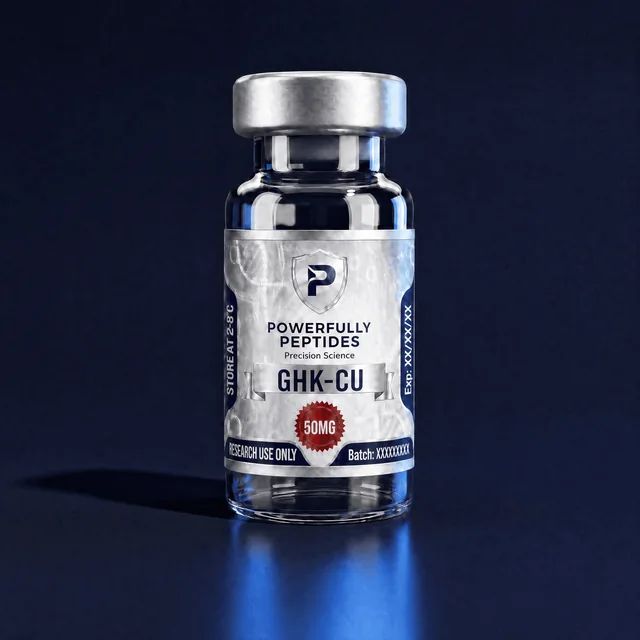
PowerfullyPeptides liefert GHK-Cu (Kupfertripeptid-1) als 50-mg-Lyophilisat an Forschungseinkäufer in ganz Europa, verfolgt versandt aus Europa. Verkauf ausschließlich für Laborforschungszwecke.
Im Labor wird GHK-Cu im Zusammenhang mit dem Umbau der extrazellulären Matrix, der Kollagen- und Matrixproteinexpression sowie kupferabhängiger Signalübertragung untersucht, meist in In-vitro-Modellen der Haut- und Kosmetikforschung. Lieferung ausschließlich für Forschungszwecke; keine Aussagen zur Anwendung bei Mensch oder Tier.
Reinheitsziel ≥99 %, chargenverfolgt. Unabhängige chargenbezogene Analysenzertifikate sind unser veröffentlichter Prüfstandard — siehe unsere COA-Seite.
€129
€50
€38
€110
€70
€30