 English
 EUR €
EUR €
In stock
Retatrutide
€110
Side-chain lactam heptapeptide, C-terminal acid alpha-MSH(4-10) analogue
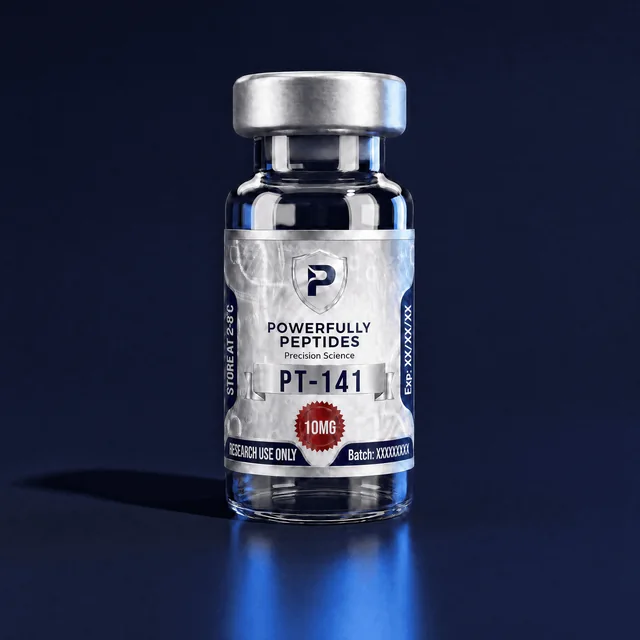
Le PT-141 (brémélanotide) est un heptapeptide cyclique synthétique et agoniste des récepteurs des mélanocortines, dérivé de l'hormone peptidique α-MSH. En recherche, il est étudié comme molécule outil au niveau des récepteurs des mélanocortines (en particulier MC4R) et s'inscrit dans les travaux in vitro sur la signalisation des mélanocortines.
Cette page s'adresse aux acheteurs de recherche en Europe qui s'approvisionnent en PT-141 pour des études de laboratoire. Nous fournissons un flacon de 10 mg exclusivement à des fins de recherche — ne convient pas à un usage humain ou vétérinaire — avec une pureté cible ≥99 %, une traçabilité par lot et une expédition suivie depuis l'Europe. Des certificats d'analyse (COA) indépendants et spécifiques au lot constituent notre standard de contrôle publié.
Vous cherchez autre chose ? Voir tous les peptides de recherche → · Calculateur de reconstitution
PT-141, international nonproprietary name bremelanotide, is a synthetic cyclic heptapeptide with the sequence Ac-Nle-cyclo[Asp-His-D-Phe-Arg-Trp-Lys]-OH. Its molecular formula is C50H68N14O10 and its average molecular weight is 1025.18 g/mol, under CAS registry number 189691-06-3. The ring is closed by a lactam bridge formed between the side-chain carboxyl of the aspartate residue and the side-chain amine of the lysine residue, so the macrocycle is a side-chain-to-side-chain linkage rather than a head-to-tail cyclisation. The N-terminus is acetylated and the C-terminus is a free carboxylic acid.
All presented information is based on scientific publications which can be found at the end of product description below.
The product is intended for scientific research and development purposes only. Chemical substances shall not be used as a drug, medicine, active substance, medical aid, cosmetic product, a substance for production of a cosmetic product neither for human consumption that is any food or food supplement or otherwise similarly used on humans or animals. Intended only for in-vitro research, such as Receptor-ligand binding studies, Enzyme activity assays, Cell proliferation assays, Cell signaling assays, Epitope mapping, ect.
Peptides in lyophilized form are supplied in glass vials by standard shipping methods and do not require refrigeration. Short-term temperature fluctuations during transport will not reduce their quality and efficacy. Even at high summer temperatures, the peptides in lyophilized form are stable for several weeks.
Upon receiving the lyophilized peptide, store at 4 °C or colder and away from bright light. Lyophilized peptides are stable at room temperature for weeks, but for longer-term storage, it is safer to store at -20 °C or colder. Exposure to moisture will greatly decrease long-term stability of lyophilized peptides. Before using the peptide, remove from cold storage and allow the peptide to equilibrate to room temperature before removing the lid of the container, in order to reduce the uptake of moisture that is present in the surrounding atmosphere.
The shelf life of peptide solutions is limited. Freezing the aliquots will prolong the storage life of the peptide. What is globally accepted for peptides in solution is that they are generally stable for 3 or more weeks at +4°C and for 3-4 months at -20°C. Avoid repeated freeze-thaw cycles, as this can degrade the peptides.
Used solely for in vitro experiments and cannot be:
Neutral reference material and handling tools from across the site. Research use only.
Compounds studied at the melanocortin receptor family.
ReferenceWhat the 0.9% benzyl alcohol preservative does, the 28-day in-use window, and which vial size fits your work.
ToolWork out the exact bacteriostatic water to add and the volume to draw for a target research concentration.
PT-141, international nonproprietary name bremelanotide, is a synthetic cyclic heptapeptide with the sequence Ac-Nle-cyclo[Asp-His-D-Phe-Arg-Trp-Lys]-OH. Its molecular formula is C50H68N14O10 and its average molecular weight is 1025.18 g/mol, under CAS registry number 189691-06-3. The ring is closed by a lactam bridge formed between the side-chain carboxyl of the aspartate residue and the side-chain amine of the lysine residue, so the macrocycle is a side-chain-to-side-chain linkage rather than a head-to-tail cyclisation. The N-terminus is acetylated and the C-terminus is a free carboxylic acid.
The molecule descends from structure-activity work on alpha-melanocyte-stimulating hormone (alpha-MSH), and specifically on the 4-10 core fragment that carries the His-Phe-Arg-Trp receptor-binding motif. Four residue positions differ from the native fragment: norleucine replaces the oxidation-prone methionine at position 4, removing the thioether that makes the parent sequence awkward to store; aspartate replaces glutamate at position 5; D-phenylalanine replaces the L-isomer at position 7; and lysine replaces glycine at position 10. The aspartate and lysine substitutions are what make the side-chain lactam possible. Bremelanotide and melanotan II share this entire scaffold and differ at exactly one point: melanotan II carries a C-terminal primary amide, bremelanotide the corresponding free acid. Compared atom by atom, the two structures are otherwise identical, which is why their formulae read C50H69N15O9 and C50H68N14O10 respectively, and why the two are not interchangeable as reference materials despite sharing a sequence and a ring.
Reference pharmacology sources describe the compound as a non-selective agonist across the melanocortin receptor family, acting at MC1, MC3, MC4 and MC5 but not at MC2, the adrenocorticotropic hormone receptor, with activity attributed primarily to MC3 and MC4 (IUPHAR/BPS Guide to Pharmacology, ligand 10408). PT-141 is the developmental code for this molecule, which was developed by Palatin Technologies. The material supplied here is a lyophilised white powder, 10 mg per vial, specified to a purity target of 99% or greater and traceable to its batch. It is not the pharmaceutical product marketed as Vyleesi, and it is supplied for laboratory research only, not for human consumption.
The preclinical record begins with the compound's original characterisation programme. Molinoff and colleagues reported that administration of PT-141 to rats and to nonhuman primates produced erectile responses, and that dosing in rats raised c-Fos immunoreactivity in hypothalamic neurons. The authors read that immunoreactivity pattern as evidence of a central rather than peripheral site of action, and the same paper reports dose-dependent erectile responses in normal men and in patients with erectile dysfunction (Molinoff et al., 2003, Ann N Y Acad Sci 994:96-102).
Early human work used subcutaneous administration. Rosen et al. dosed healthy male volunteers across a 0.3 to 10 mg range and reported statistically significant RigiScan-measured erectile responses at doses above 1.0 mg in the absence of visual sexual stimulation. A second arm enrolled men with an inadequate response to sildenafil, defined in the protocol as an erection suitable for vaginal penetration occurring 50% of the time or less while taking 100 mg Viagra, and compared placebo against 4 mg and 6 mg in a crossover design with visual sexual stimulation present. Both active doses reached statistical significance on the same instrument (Rosen et al., 2004, Int J Impot Res 16:135-142).
The programme subsequently moved to premenopausal women. In a 12-week randomised placebo-controlled dose-finding trial with 327 participants, Clayton et al. compared self-administered subcutaneous doses of 0.75, 1.25 and 1.75 mg against placebo. The pooled 1.25 and 1.75 mg arms recorded an increase of 0.7 satisfying sexual events per month against 0.2 for placebo (p = 0.0180), a change of +3.6 versus +1.9 on the Female Sexual Function Index (p = 0.0017), and a change of -11.1 versus -6.8 on the Female Sexual Distress Scale (p = 0.0014). Nausea, flushing and headache were the adverse events recorded most frequently (Clayton et al., 2016, Womens Health (Lond) 12:325-337).
Two identically designed phase 3 trials of 1.75 mg dosed as needed over 24 weeks, reported together as RECONNECT, randomised 1,267 women, giving a safety population of 1,247 and a modified intent-to-treat efficacy population of 1,202. Kingsberg et al. reported increases on the Female Sexual Function Index desire domain of 0.30 in study 301 and 0.42 in study 302, integrated 0.35 (p less than 0.001), and changes on Female Sexual Distress Scale item 13 of -0.37 in study 301 (p less than 0.001) and -0.29 in study 302 (p = 0.005), integrated -0.33 (p less than 0.001). Nausea, flushing and headache each occurred in 10% or more of recipients in both studies. That efficacy record has been formally contested, and the contest is part of the published record. Spielmans re-analysed the same trials and reported that 72.72% of protocol-listed outcomes were not reported, with 15 secondary measures absent from the protocol presented instead. The same analysis calculated an odds ratio of 11.98 for discontinuation due to adverse events (95% CI 3.74 to 38.37, number needed to harm 6) and an odds ratio of 0.30 for participants preferring the active compound over placebo (95% CI 0.24 to 0.38, number needed to harm 4). Kingsberg and co-authors published a formal commentary in the same journal disputing that methodology (Kingsberg et al., 2021, J Sex Res 58:1106-1107). Anyone treating this literature as settled should read both papers.
Two lines of work sit outside the sexual-function literature entirely. Zhang et al. solved cryo-electron microscopy structures of full-length MC4R in complex with the heterotrimeric Gs protein bound to four ligands, bremelanotide among them alongside alpha-MSH, afamelanotide and the small-molecule ligand THIQ, and reported on ligand recognition, receptor activation and subtype selectivity. That work is the primary structural reference for how this ligand engages the receptor (Zhang et al., 2021, Cell Res 31:1163-1175). Separately, Spana et al. pooled two phase 1 trials in women with obesity. In study A, 30 participants received three subcutaneous doses daily for 15 days, and the treated group differed from placebo by a mean of 1.3 kg in body weight (95% CI -1.9 to -0.8, p less than 0.0001), with caloric intake roughly 400 kcal per day lower. In study B, 27 participants in a crossover design receiving twice-daily dosing showed a 1.7 kg change against 0.9 kg on placebo (p less than 0.001). Two further trials in this literature, both by Safarinejad, are excluded here: the 2008 Journal of Sexual Medicine paper has been retracted, and the 2008 Journal of Urology paper carries an Expression of Concern issued in 2023.
PowerfullyPeptides fournit le PT-141 (brémélanotide) sous forme de lyophilisat de 10 mg aux acheteurs de recherche dans toute l'Europe, expédié en suivi depuis l'Europe. Vente réservée exclusivement à la recherche en laboratoire.
En laboratoire, le PT-141 est étudié comme agoniste des récepteurs des mélanocortines et molécule outil, surtout dans les travaux in vitro sur la signalisation des mélanocortines (MC4R). Il est fourni exclusivement à des fins de recherche ; nous ne formulons aucune allégation quant à un usage humain ou animal.
Pureté cible ≥99 %, traçabilité par lot. Des certificats d'analyse indépendants et spécifiques au lot constituent notre standard de contrôle publié — voir notre page COA.
€110
€129
€35
€50
€50
€70