 English
 EUR €
EUR €
In stock
NAD+
€63.95
Nicotinamide adenine dinucleotide (NAD+) · Dinucleotide coenzyme; not a peptide
Nicotinamide adenine dinucleotide is not a peptide. It is a dinucleotide: two ribonucleotides, one bearing nicotinamide and one adenine, joined through their 5′-phosphate groups by a pyrophosphate bridge. The nicotinamide is attached to its ribose in the beta configuration. The plus sign in NAD+ denotes a formal charge on the nicotinamide ring; it does not specify a salt form.
Supplied for laboratory research only. Not for human or veterinary use, consumption or self-administration.
Inspect the vial and seal on arrival. Contact us about damage or an unexpected condition. Transport alone does not establish chemical stability or suitability for an experiment.
Follow the instructions supplied with the material and your laboratory’s validated procedure. Keep the vial sealed and protect it from moisture and light. Confirm product-specific temperature and shelf-life information before use.
Solvent, pH, concentration and storage conditions depend on the material and assay. Use a validated laboratory protocol; a general mixing calculator does not establish compatibility, sterility or solution shelf life.
No independent report is currently linked to this new strength.
Published papers are not certificates for this vial. Ask for the applicable analytical documentation; reports for another product or strength do not verify this listing.
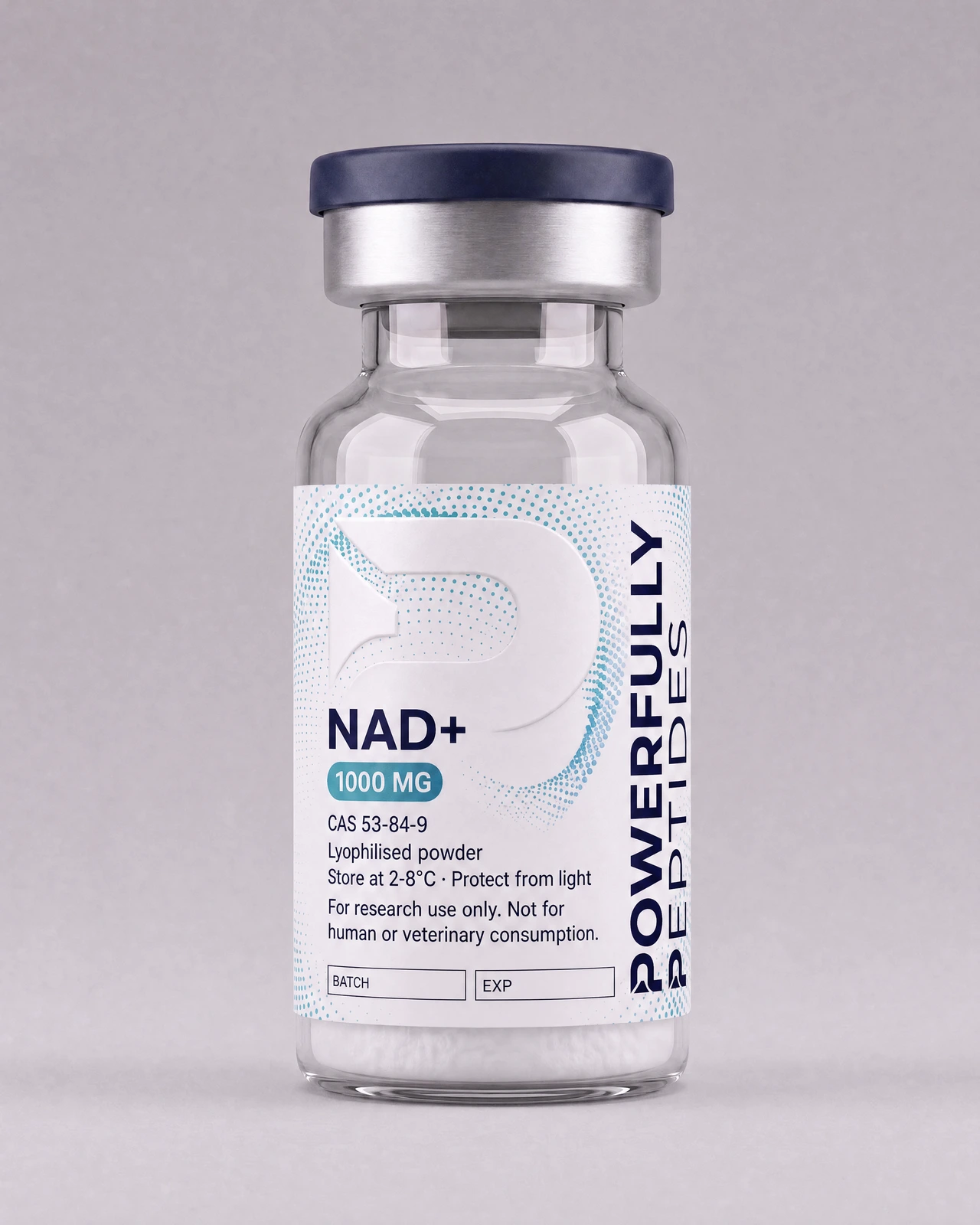
1 vial · 1000 mg · Lyophilised powder. The stated milligrams describe total vial content, not a dose or the concentration of a prepared solution.
No independent report is currently linked to this new strength. Published papers are not certificates for this vial. Ask for the applicable analytical documentation; reports for another product or strength do not verify this listing.
Yes. Select the quantity, add this vial to your cart or choose Buy now. Other vial strengths are listed separately.
The cited studies describe particular experimental materials and conditions. They do not test this supplied vial or establish its suitability for human or veterinary use.
Reference material and handling tools. Research use only.
Published papers are not certificates for this vial. Ask for the applicable analytical documentation; reports for another product or strength do not verify this listing.
DocumentationNo independent report is currently linked to this new strength.
Peptide calculatorSupplied for laboratory research only. Not for human or veterinary use, consumption or self-administration.
Nicotinamide adenine dinucleotide is not a peptide. It is a dinucleotide: two ribonucleotides, one bearing nicotinamide and one adenine, joined through their 5′-phosphate groups by a pyrophosphate bridge. The nicotinamide is attached to its ribose in the beta configuration. The plus sign in NAD+ denotes a formal charge on the nicotinamide ring; it does not specify a salt form.
Reduction of the nicotinamide ring produces NADH, forming the NAD+/NADH redox pair. Both oxidation states absorb near 260 nm through the adenine portion, while the reduced form also absorbs near 340 nm. Tracking that second signal is a standard way to follow enzyme turnover in biochemical assays. This analytical distinction does not make NADH interchangeable with NAD+.
In cells, NAD+ can be assembled de novo from tryptophan, from nicotinic acid through the Preiss–Handler pathway, or by recycling nicotinamide through NAMPT and NMNAT. NAD+ also acts as a co-substrate for enzymes including sirtuins and PARPs. Molecular formulae and masses depend on the depicted protonation and salt form; this 1000 mg listing does not assign a counter-ion or analytical specification from a general molecular description.
The literature on intracellular NAD+ biochemistry must be separated from studies that administer intact NAD+. The human literature on the precursors nicotinamide riboside (NR) and nicotinamide mononucleotide (NMN) is a third category. They are different molecules with different transport and metabolism, so precursor findings are not studies of this intact dinucleotide.
Grant and colleagues described their plasma-and-urine metabolome investigation as a pilot study. The later randomised study by Yu and colleagues examined a specific heart-failure population: a cardiac-function endpoint favoured the NAD+ arm, while several secondary clinical endpoints did not reach significance. The authors called for larger multicentre validation. These findings cannot establish general anti-ageing or wellness benefits.
The precursor work likewise needs precise interpretation. Martens and colleagues measured cellular NAD+ after NR supplementation. Elhassan and colleagues observed changes in the muscle NAD+ metabolome while mitochondrial bioenergetics remained unchanged. These are biochemical endpoints, not interchangeable clinical outcomes. Read precursor trials as adjacent evidence, not as tests of this 1000 mg research vial.
€63.95
€3.94