 English
 EUR €
EUR €

In stock
SS-31
€58.95
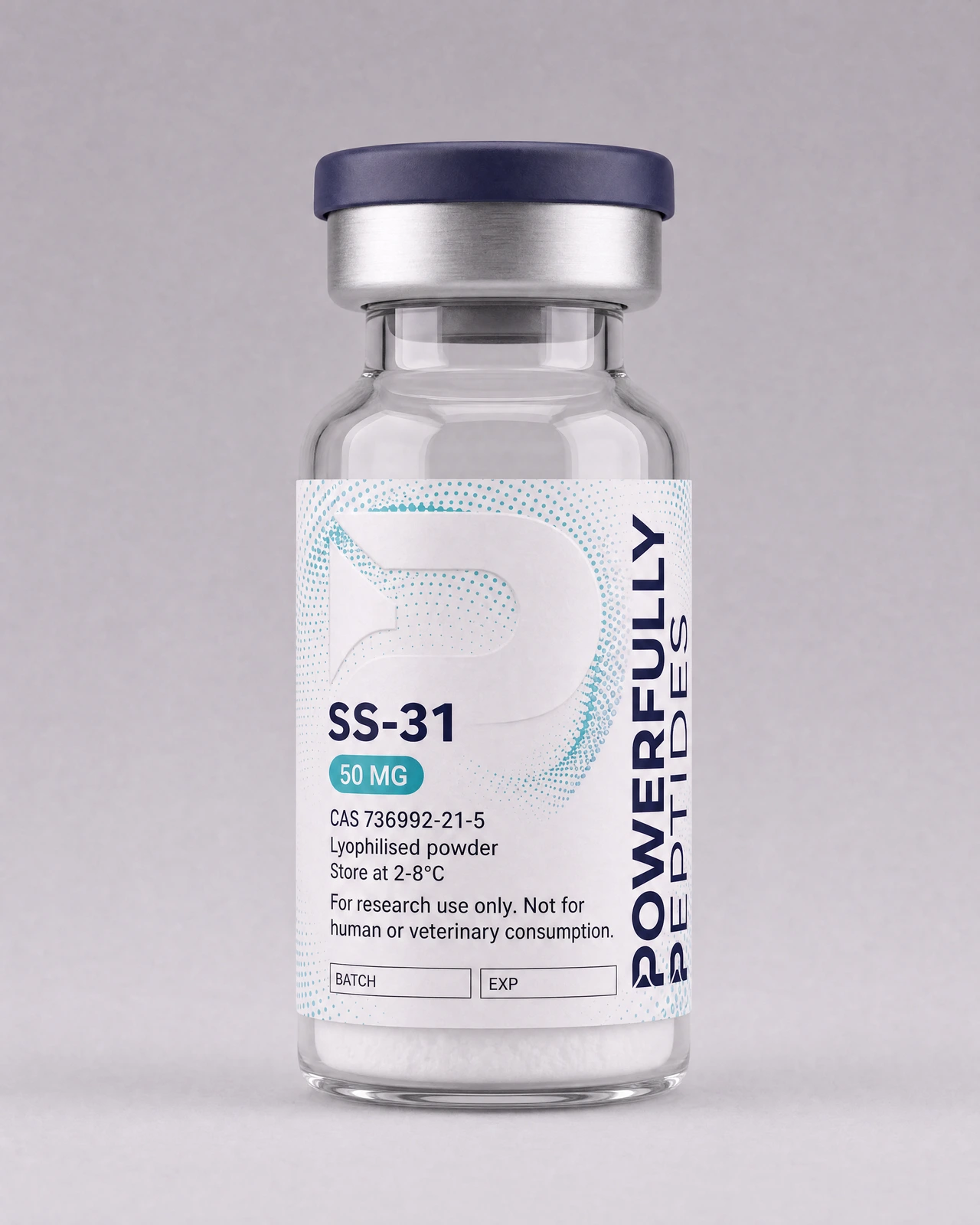
SS-31 (elamipretide) · Tetrapeptide
SS-31 is a synthetic tetrapeptide with the sequence D-Arg-Dmt-Lys-Phe-NH2, in which Dmt denotes 2′,6′-dimethyl-L-tyrosine. Two of the four residues are non-standard: the N-terminal arginine has the D configuration and the tyrosine carries two methyl substituents. The C-terminus is an amide, not a free carboxylic acid. Aromatic and basic residues alternate along the chain, the structural motif described for this peptide class by Zhao and colleagues (2004).
Supplied for laboratory research only. Not for human or veterinary use, consumption or self-administration.
Inspect the vial and seal on arrival. Contact us about damage or an unexpected condition. Transport alone does not establish chemical stability or suitability for an experiment.
Follow the instructions supplied with the material and your laboratory’s validated procedure. Keep the vial sealed and protect it from moisture and light. Confirm product-specific temperature and shelf-life information before use.
Solvent, pH, concentration and storage conditions depend on the material and assay. Use a validated laboratory protocol; a general mixing calculator does not establish compatibility, sterility or solution shelf life.
No independent report is currently linked to this new strength.
Published papers are not certificates for this vial. Ask for the applicable analytical documentation; reports for another product or strength do not verify this listing.
1 vial · 50 mg · Lyophilised powder. The stated milligrams describe total vial content, not a dose or the concentration of a prepared solution.
No independent report is currently linked to this new strength. Published papers are not certificates for this vial. Ask for the applicable analytical documentation; reports for another product or strength do not verify this listing.
Yes. Select the quantity, add this vial to your cart or choose Buy now. Other vial strengths are listed separately.
The cited studies describe particular experimental materials and conditions. They do not test this supplied vial or establish its suitability for human or veterinary use.
Reference material and handling tools. Research use only.
Published papers are not certificates for this vial. Ask for the applicable analytical documentation; reports for another product or strength do not verify this listing.
DocumentationNo independent report is currently linked to this new strength.
Peptide calculatorSupplied for laboratory research only. Not for human or veterinary use, consumption or self-administration.
SS-31 is a synthetic tetrapeptide with the sequence D-Arg-Dmt-Lys-Phe-NH2, in which Dmt denotes 2′,6′-dimethyl-L-tyrosine. Two of the four residues are non-standard: the N-terminal arginine has the D configuration and the tyrosine carries two methyl substituents. The C-terminus is an amide, not a free carboxylic acid. Aromatic and basic residues alternate along the chain, the structural motif described for this peptide class by Zhao and colleagues (2004).
The SS designation comes from the Szeto–Schiller series. The same molecule is called elamipretide and appears in the literature under the development names MTP-131, Bendavia and RX-31. The free-peptide formula is C32H49N9O5 and its molecular mass is approximately 639.80 g/mol. These are literature descriptors; they do not establish the salt form or analytical identity of this 50 mg vial.
The compound entered the literature among cell-permeable peptide antioxidants designed to reach the inner mitochondrial membrane. Zhao and colleagues studied reactive oxygen species, mitochondrial swelling and cytochrome c release in cells and isolated mitochondria. Analogues without dimethyltyrosine did not reproduce several effects in those assays. These were model-specific experiments, not tests of the supplied catalogue material.
Birk and colleagues (2013) investigated binding to cardiolipin, an anionic phospholipid of the inner mitochondrial membrane, and studied renal-ischaemia models. Mitchell and colleagues (2020) later examined model and mitochondrial membranes, linking peptide binding to membrane surface charge and changes in lipid packing and surface electrostatics. The studies describe related but distinct experimental questions.
The clinical findings are mixed. The small MMPOWER study did not reach conventional significance for its highest-dose versus placebo walking-distance comparison. In the larger MMPOWER-3 trial, neither six-minute walking distance nor fatigue improved significantly against placebo. The randomised phase of TAZPOWER also missed its primary endpoints; improvements reported in the subsequent open-label extension came from an uncontrolled phase. These distinctions are essential when interpreting the references and do not establish clinical benefits for this research vial.
€58.95

€3.94