 English
 EUR €
EUR €
In stock
Wolverine Blend
€44.95
BPC-157 + TB-500 · Two-component blend
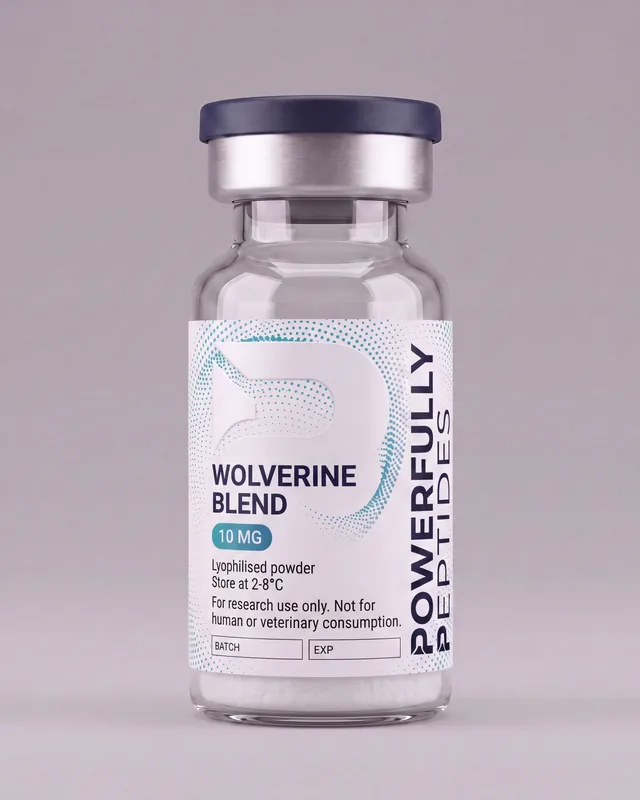
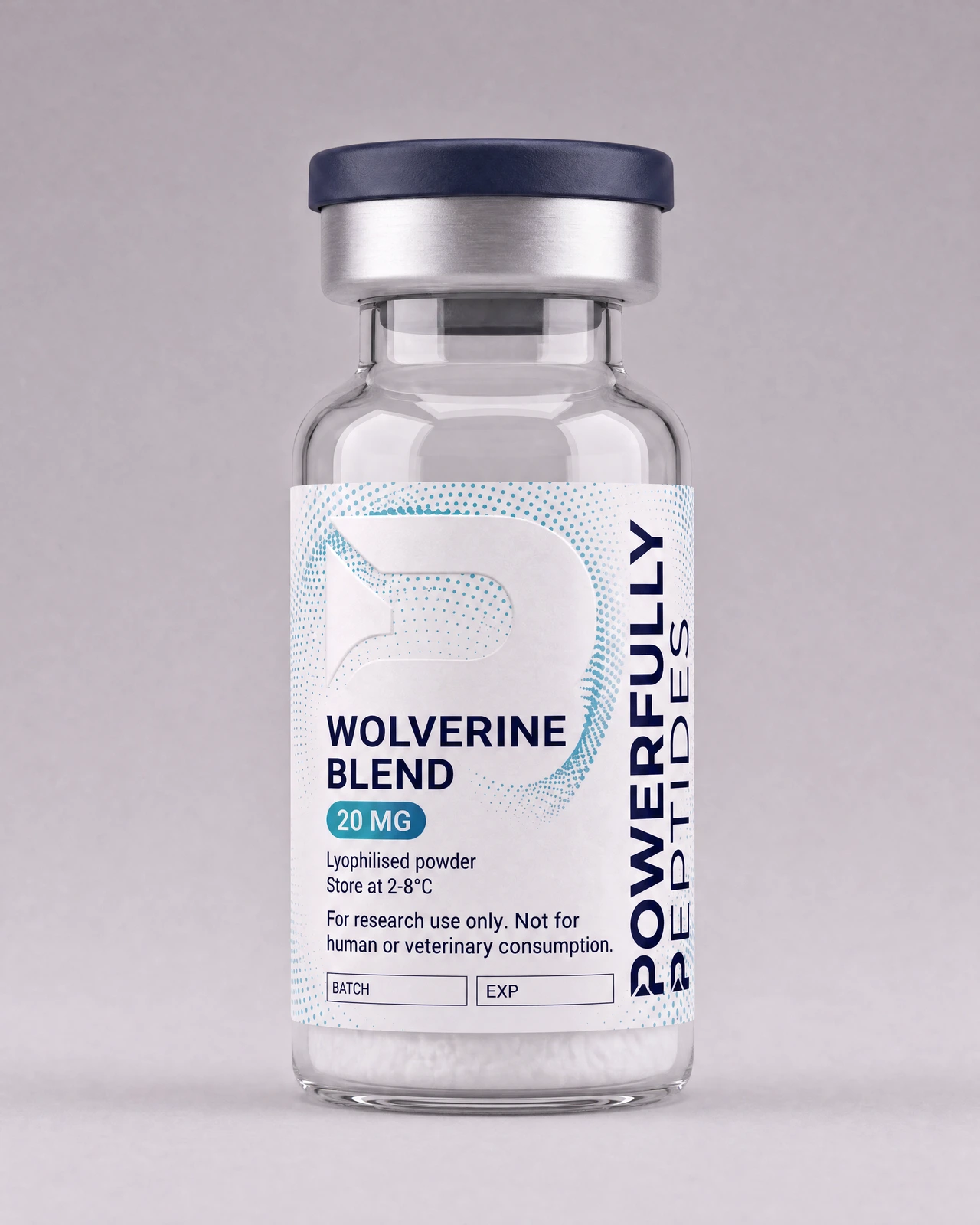
Wolverine Blend 20 mg is one combined vial containing BPC-157 10 mg and TB-500 10 mg. These are the stated product quantities. Published reports for individual components are not an independent analysis of the finished blend and do not establish its purity, compatibility or performance.
Supplied for laboratory research only. Not for human or veterinary use, consumption or self-administration.
Inspect the vial and seal on arrival. Contact us about damage or an unexpected condition. Transport alone does not establish chemical stability or suitability for an experiment.
Follow the instructions supplied with the material and your laboratory’s validated procedure. Keep the vial sealed and protect it from moisture and light. Confirm product-specific temperature and shelf-life information before use.
Solvent, pH, concentration and storage conditions depend on the material and assay. Use a validated laboratory protocol; a general mixing calculator does not establish compatibility, sterility or solution shelf life.
No independent report is currently linked to this new strength.
Published papers are not certificates for this vial. Ask for the applicable analytical documentation; reports for another product or strength do not verify this listing.
1 vial · 20 mg · Lyophilised powder. BPC-157 10 mg + TB-500 10 mg in one vial. The stated milligrams describe total vial content, not a dose or the concentration of a prepared solution.
No independent report is currently linked to this new strength. Published papers are not certificates for this vial. Ask for the applicable analytical documentation; reports for another product or strength do not verify this listing.
Yes. Select the quantity, add this vial to your cart or choose Buy now. Other vial strengths are listed separately.
The cited studies describe particular experimental materials and conditions. They do not test this supplied vial or establish its suitability for human or veterinary use.
Reference material and handling tools. Research use only.
Published papers are not certificates for this vial. Ask for the applicable analytical documentation; reports for another product or strength do not verify this listing.
DocumentationNo independent report is currently linked to this new strength.
Peptide calculatorSupplied for laboratory research only. Not for human or veterinary use, consumption or self-administration.
Wolverine Blend 20 mg is one combined vial containing BPC-157 10 mg and TB-500 10 mg. These are the stated product quantities. Published reports for individual components are not an independent analysis of the finished blend and do not establish its purity, compatibility or performance.
BPC-157 is a pentadecapeptide with the sequence Gly-Glu-Pro-Pro-Pro-Gly-Lys-Pro-Ala-Asp-Asp-Ala-Gly-Leu-Val, abbreviated GEPPPGKPADDAGLV. Four of its fifteen residues are proline, three consecutively at positions 3–5. It has no cysteine and therefore no disulfide bridge. The free peptide and its salt forms must be distinguished when comparing analytical records; a molecular description alone does not identify the material in a particular vial.
TB-500 is a trade designation rather than an unambiguous chemical name. Thymosin beta-4 is a 43-residue protein, while Esposito and colleagues identified an acetylated seven-residue fragment, Ac-LKKTETQ, in the TB-500 preparation they analysed. The fragment and the full-length protein are different materials. The product name alone does not resolve which sequence is present in a supplied preparation.
The two constituents have different research records and should be read separately. Chang and colleagues studied BPC-157 in rat tendon explants and fibroblasts, examining outgrowth, survival and migration; migration findings were not evidence of a direct proliferative effect in that experiment. Hsieh and colleagues investigated VEGFR2-related signalling in endothelial cells and animal models. These are preclinical findings, not tests of this blend.
Much of the thymosin beta-4 literature concerns the full-length protein, including wound and cardiac models and a small ophthalmic study. Such findings cannot be transferred automatically to the seven-residue TB-500 fragment. None of the cited component studies evaluates the exact BPC-157 10 mg + TB-500 10 mg combined vial, so additive effects, interactions and stability are not established by these references.
€44.95
€3.94