 English
 EUR €


In stock
GLP-3-RT
€88.95

Lyophilised research material
For laboratory research only. Not for human or animal use.
Testing information · Delivery · Returns
MOTS-c stands for mitochondrial open reading frame of the 12S rRNA type-c. It is a 16-amino-acid peptide with the sequence MRWQEMGYIFYPRKLR. What makes it structurally unusual among laboratory peptides is where its coding sequence sits: not in the nuclear genome, but inside MT-RNR1, the mitochondrial gene for the 12S ribosomal RNA. It belongs to a small group of molecules described as mitochondrial-derived peptides (MDPs), a group that also includes humanin and the SHLP series. The peptide was characterised in a 2015 report in Cell Metabolism from Changhan Lee and colleagues at the University of Southern California (Lee et al., 2015).
All presented information is based on scientific publications which can be found at the end of product description below.
The product is intended for scientific research and development purposes only. Chemical substances shall not be used as a drug, medicine, active substance, medical aid, cosmetic product, a substance for production of a cosmetic product neither for human consumption that is any food or food supplement or otherwise similarly used on humans or animals. Intended only for in-vitro research, such as Receptor-ligand binding studies, Enzyme activity assays, Cell proliferation assays, Cell signaling assays, Epitope mapping, ect.
Peptides in lyophilized form are supplied in glass vials by standard shipping methods and do not require refrigeration. Short-term temperature fluctuations during transport will not reduce their quality and efficacy. Even at high summer temperatures, the peptides in lyophilized form are stable for several weeks.
Upon receiving the lyophilized peptide, store at 4 °C or colder and away from bright light. Lyophilized peptides are stable at room temperature for weeks, but for longer-term storage, it is safer to store at -20 °C or colder. Exposure to moisture will greatly decrease long-term stability of lyophilized peptides. Before using the peptide, remove from cold storage and allow the peptide to equilibrate to room temperature before removing the lid of the container, in order to reduce the uptake of moisture that is present in the surrounding atmosphere.
The shelf life of peptide solutions is limited. Freezing the aliquots will prolong the storage life of the peptide. What is globally accepted for peptides in solution is that they are generally stable for 3 or more weeks at +4°C and for 3-4 months at -20°C. Avoid repeated freeze-thaw cycles, as this can degrade the peptides.
Used solely for in vitro experiments and cannot be:
Published studies investigate metabolism and physical performance. Lee et al. (2015) reported effects on insulin resistance and diet-induced obesity in mice. These findings do not establish benefits from using this research vial in people.
No. The human part of Reynolds et al. (2021) measured naturally occurring MOTS-c after exercise in ten young men. The peptide-treatment experiments were in mice. Observing a response to exercise is different from testing an administered treatment in humans.
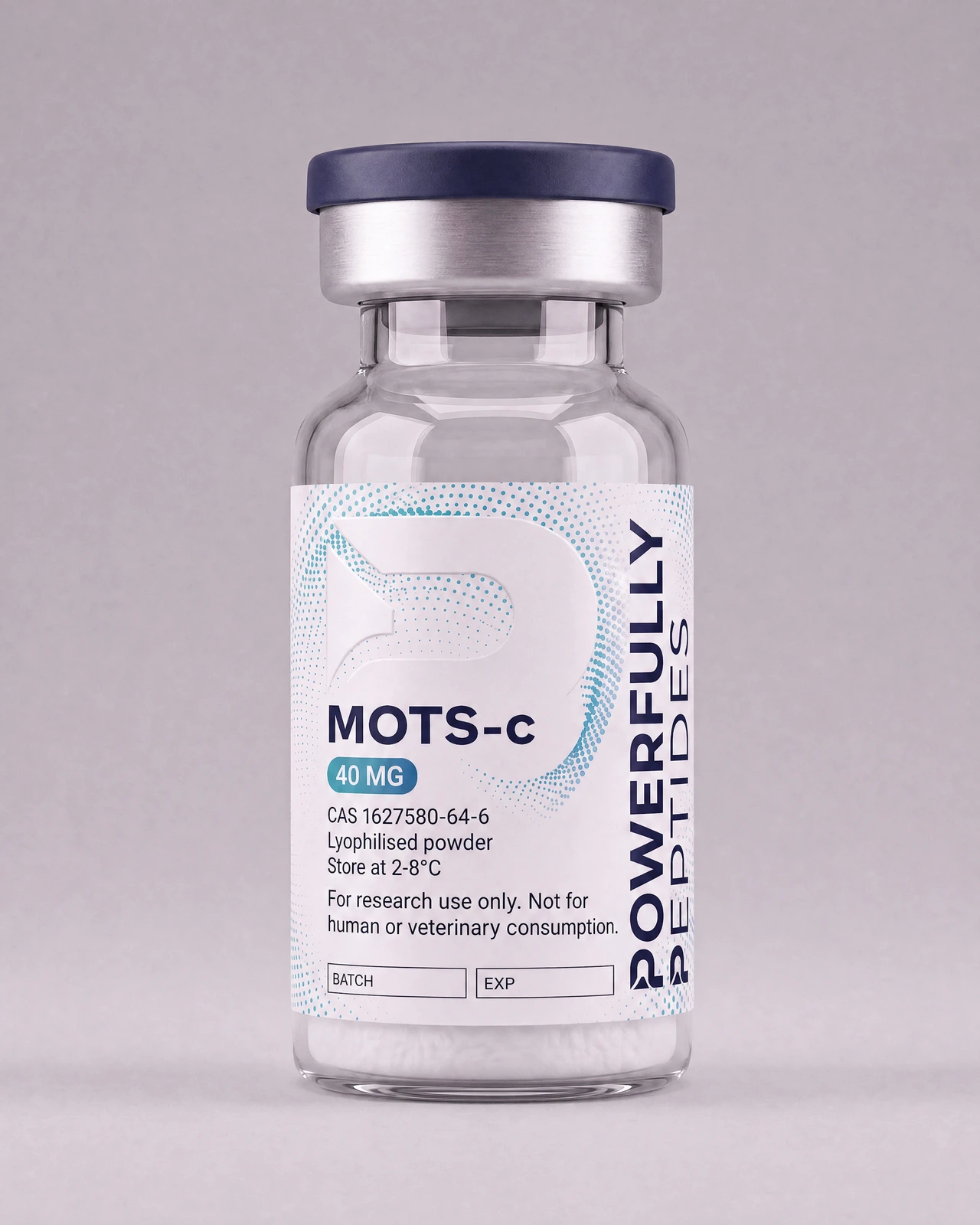
The catalogue listing is a 10 mg lyophilised MOTS-C vial for laboratory research. The vial size is a mass specification, not the concentration of a prepared solution. Use the laboratory concentration calculator with your chosen final volume.
Yes. The MOTS-c 40 mg vial has four times the stated mass of this 10 mg format. Compare the current prices and specifications on the two pages.
No independent MOTS-C report is currently listed in our certificate library. A catalogue purity specification is not an independent test result. Ask about available documentation before ordering if your work requires it.
No. MOTS-C and NAD+ are separate compounds with different product specifications. This page is for MOTS-C only; compare the identity and stated quantity on each listing.
See shipping and returns for delivery information. Available payment options are shown at checkout. For a destination or order question, contact us before ordering.
Neutral reference material and handling tools from across the site. Research use only.
Compare the two catalogue specifications and documentation status.
ReferenceWhat the 0.9% benzyl alcohol preservative does, the 28-day in-use window, and which vial size fits your work.
ToolWork out the exact bacteriostatic water to add and the volume to draw for a target research concentration.
MOTS-c stands for mitochondrial open reading frame of the 12S rRNA type-c. It is a 16-amino-acid peptide with the sequence MRWQEMGYIFYPRKLR. What makes it structurally unusual among laboratory peptides is where its coding sequence sits: not in the nuclear genome, but inside MT-RNR1, the mitochondrial gene for the 12S ribosomal RNA. It belongs to a small group of molecules described as mitochondrial-derived peptides (MDPs), a group that also includes humanin and the SHLP series. The peptide was characterised in a 2015 report in Cell Metabolism from Changhan Lee and colleagues at the University of Southern California (Lee et al., 2015).
The molecular formula is C101H152N28O22S2 and the molecular weight of the free peptide is 2174.62 g/mol (CAS 1627580-64-6). The two sulfur atoms come from methionine residues at positions 1 and 6. The sequence also contains a single tryptophan at position 3, two tyrosines, a proline at position 12, and four basic residues (three arginines and one lysine), which give the molecule a strongly cationic character at neutral pH. Those methionine and tryptophan residues are the chemically labile points of the molecule and the reason oxidising conditions and prolonged light exposure are avoided during handling.
Material supplied for laboratory work is produced by solid-phase peptide synthesis and lyophilised. Synthetic peptides of this class are commonly isolated as an acetate or trifluoroacetate salt, and the counter-ion adds mass beyond the 2174.62 g/mol free-peptide figure. This is worth noting because catalogue listings for the trifluoroacetate form give a formula weight of about 2288.6 for C101H152N28O22S2 combined with CF3COOH (Cayman Chemical item 29785), so a higher mass quoted by a supplier usually indicates the salt rather than a different molecule. PubChem indexes the trifluoroacetate form under the same compound record. Sequence conservation has been noted as a feature of the peptide: a review by Mohtashami and colleagues reports that the first 11 residues are highly conserved across 14 mammalian species (Mohtashami et al., 2022).
MOTS-c is a 16-residue peptide with the sequence MRWQEMGYIFYPRKLR. This catalogue entry specifies a 10 mg vial. No independent analytical result for this product is currently published on this site. The scientific references below describe research on the named compound; they do not certify the identity, purity or performance of the supplied material.
€88.95

€101.95

€34.95

€49.95

€63.95
€104.95